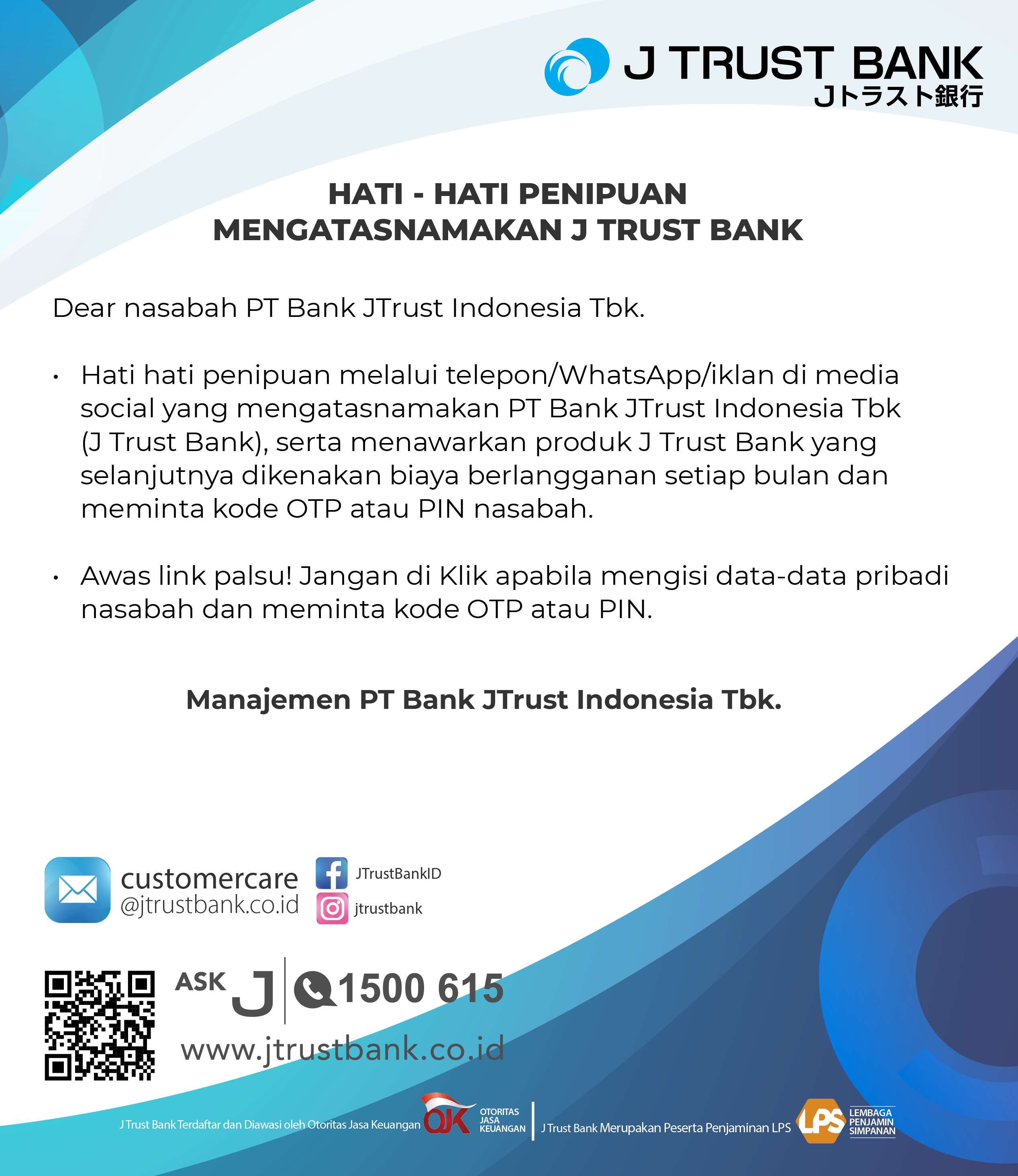

The Bank is always committed to maintaining the security of funds and the confidentiality of customer personal data. Therefore, the Bank urges all customers to remain vigilant against the risk of account misuse through account buying and selling practices, which can be exploited by irresponsible parties to commit crimes.
Bank account trading is the practice of handing over or trading accounts, ATM cards, or access to banking services to another party for use in the account holder's name. This activity generally involves someone opening a bank account and then intentionally or unknowingly handing over control and/or access to the account to another party for use. Account trading is illegal and high-risk, both for the party handing over or selling and the party using the account, and can potentially be misused for criminal and unlawful activities. This activity is prohibited and carries the risk of legal consequences and financial loss.
Bank Account Buying and Selling Method of Operation
Fraudsters use various methods to exploit customers' ignorance or negligence to induce them to hand over their bank accounts, allowing them to use them for their own gain. Fraudsters typically employ narratives that appear legitimate but actually lead to illegal activities. Some common methods include:
- The Lure of Cash Rewards
The perpetrator offers a sum of money to the victim or customer to open a new account or hand over access to an existing account, which is then used by another party.
- Buy an Active Account
The perpetrator looks for customer victims who are willing to sell their active personal accounts and give the victim a sum of money, then the account is misused for illegal transactions.
- Suspicious Financial Transactions
Without realizing it, the victim/customer's account receives funds from an unknown party without a clear purpose, which could be an indication that the account is being used as a means of storing funds from criminal acts.
Risks for Account Owners
- Supporting criminal activities
Many online fraudsters and digital crime syndicates use other people's accounts to store the proceeds of crime so they can avoid detection.
- Legal Responsibility
The account owner can be held responsible for all legal risks from misuse of the account even if he/she does not use the account for illegal acts.
- Account Blocking and Banking Blacklisting
Accounts suspected of containing proceeds of crime may be blocked, and the account holder may be placed on the bank's blacklist. In the long term, this will make it difficult to apply for other financial products, such as mortgages, credit cards, or loans.
- Misuse of Personal Data
Personal data can be stolen and used by irresponsible parties for other criminal acts.
Risks for Account Users or Buyers
The use of an account in the name of another party to hold or distribute funds resulting from criminal acts may potentially be subject to legal sanctions in accordance with the provisions of applicable laws and regulations.
Legal Consequences
The practice of buying and selling and misusing bank accounts can be categorized as an unlawful act and has the potential to result in criminal and administrative sanctions in accordance with applicable provisions.
How to Avoid Account Buying and Selling
- Don't be tempted by the promise of cash rewards for selling or lending accounts.
- Always maintain the confidentiality of personal and banking data including account numbers, debit cards, PINs, OTPs, and mobile and internet banking access.
- Use the account only for legitimate personal purposes.
- Immediately report to the Bank if there are suspicious transactions or activities on your J-Mobile and J-Net accounts
If you find any indication of account misuse or suspicious transaction activity and require further information, immediately contact Bank JTrust Indonesia via:
- J Trust Call 1500615,
- J Trust Bank website at https://www.jtrustbank.co.id/.
- Or visit a branch office Bank JTrust Indonesia terdekat
The Bank invites all customers to work together to maintain transaction security and prevent account misuse for mutual convenience and protection.